漢字
Chinese
| Chinese; name of a dynasty; man | letter; symbol; character letter; symbol; character; word | ||
|---|---|---|---|
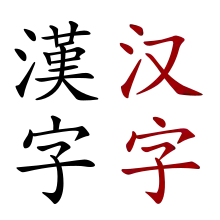
| trad. (漢字) | 漢 | 字 | |
| simp. (汉字) | 汉 | 字 | |
Pronunciation
Noun
漢字
- Chinese character; Han character; hanzi
- 顯宗曰:「每日先教漢字,至申時漢字課畢,教女直小字,習國朝語。」 [Classical Chinese, trad.]
- From: 1343-1345, 《金史·卷九十八·完顏匡》 (History of Jin)
- Xiǎnzōng yuē: “Měirì xiān jiào hànzì, zhì shēn shí hànzì kè bì, jiào nǚzhí xiǎo zì, xí guócháo yǔ.” [Pinyin]
- Xiǎnzōng said: “Every day first teach hanzi, until 3–5pm when hanzi class ends. Teach the Jurchen people small characters, and they will learn the language of this dynasty.”
显宗曰:「每日先教汉字,至申时汉字课毕,教女直小字,习国朝语。」 [Classical Chinese, simp.]- 不錯,漢字是古代傳下來的寶貝,但我們的祖先,比漢字還要古,所以我們更是古代傳下來的寶貝。爲漢字而犧牲我們,還是爲我們而犧牲漢字呢? [MSC, trad.]
- From: 1934, 魯迅 (Lu Xun) 《漢字和拉丁化》 (Han character and its Latinization)
- Bùcuò, hànzì shì gǔdài chuán xiàlái de bǎobèi, dàn wǒmen de zǔxiān, bǐ hànzì hái yào gǔ, suǒyǐ wǒmen gèng shì gǔdài chuán xiàlái de bǎobèi. Wèi hànzì ér xīshēng wǒmen, háishì wèi wǒmen ér xīshēng hànzì ne? [Pinyin]
- Yes, Chinese characters are a treasure passed down from antiquity, but our ancestors are even more ancient, so we are more so a treasure passed down from antiquity. Will we sacrifice Chinese characters for our sake, or will we sacrifice ourselves for the sake of Chinese characters?
不错,汉字是古代传下来的宝贝,但我们的祖先,比汉字还要古,所以我们更是古代传下来的宝贝。为汉字而牺牲我们,还是为我们而牺牲汉字呢? [MSC, simp.]
Synonyms
Derived terms
Japanese
Etymology
| Kanji in this term | |
|---|---|
| 漢 | 字 |
| かん Grade: 3 |
じ Grade: 1 |
| goon | |
| Alternative spelling |
|---|
| 漢字 (kyūjitai) |
From Middle Chinese compound 漢字 (MC xanH dziH, literally “Han Chinese + character”). Compare modern Mandarin 漢字/汉字 (hànzì), Min Nan 漢字/汉字 (hàn-jī).
Usage notes
The term literally means “Chinese characters”, and refers broadly to any such ideographic or logographic character originating in written Chinese, or created anew along similar lines. This latter category includes some characters created in Japan from originally Chinese elements and called 国字 (kokuji, literally “national (i.e. Japanese) characters”), and other characters that were modified over time into distinctly Japanese forms and called 新字体 (shinjitai, literally “new character forms”). Contrast with 仮名 (kana, literally “borrowed label”), uniquely Japanese phonetic characters derived either from cursive forms of kanji (the 平仮名 (hiragana)) or from shorthand that abbreviated characters to use just specific parts of the original kanji (the 片仮名 (katakana)).
Hyponyms
- 国字 (kokuji)
- 和製漢語 (wasei kango)
- 和製漢字 (wasei kanji)
Derived terms
Descendants
See also
References
- NHK Broadcasting Culture Research Institute, editor (1998), NHK日本語発音アクセント辞典 [NHK Japanese Pronunciation Accent Dictionary] (in Japanese), Tōkyō: NHK Publishing, →ISBN
- Matsumura, Akira, editor (2006), 大辞林 [Daijirin] (in Japanese), Third edition, Tōkyō: Sanseidō, →ISBN
- Kindaichi, Kyōsuke et al., editors (1997), 新明解国語辞典 [Shin Meikai Kokugo Jiten] (in Japanese), Fifth edition, Tōkyō: Sanseidō, →ISBN
Okinawan
Etymology
| Kanji in this term | |
|---|---|
| 漢 | 字 |
| かん Grade: 3 |
じ Grade: 1 |
| on’yomi | |
| Alternative spelling |
|---|
| 漢字 (kyūjitai) |
Attested in the 沖縄語典 (Okinawa Goten, “Okinawan Dictionary”) as かんじ.[1]
References
- 1896: 沖縄語典 (Okinawa Goten, “Okinawan Dictionary”). In Japanese. http://kindai.ndl.go.jp/info:ndljp/pid/992016/28