漁師
Japanese
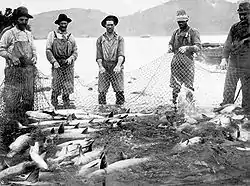
漁師 (ryōshi): salmon fishermen in Oregon, 1914.
| Kanji in this term | |
|---|---|
| 漁 | 師 |
| りょう Grade: 4 |
し Grade: 5 |
| on’yomi | |
Etymology
The spelling is likely from Middle Chinese compound 漁師/渔师 (ngjo srij, literally “fishing + master”). Compare modern Mandarin 漁師/渔师 (yúshī, “fisherman”).
The expected reading would be gyoshi. The kan'yōyomi (irregular but customary reading) of ryō for the 漁 character is from confusion with the 猟 character, usually read ryō in on'yomi contexts and meaning “hunt, hunting”, as used in the homophonic term 猟師 (ryōshi, “hunter”).[1]
Synonyms
References
- Shōgaku Tosho (1988) 国語大辞典(新装版) [Unabridged Dictionary of Japanese (Revised Edition)] (in Japanese), Tōkyō: Shogakukan, →ISBN
- Matsumura, Akira, editor (2006), 大辞林 [Daijirin] (in Japanese), Third edition, Tōkyō: Sanseidō, →ISBN
This article is issued from Wiktionary. The text is licensed under Creative Commons - Attribution - Sharealike. Additional terms may apply for the media files.