三振
Japanese
| Kanji in this term | |
|---|---|
| 三 | 振 |
| さん Grade: 1 |
しん Grade: S |
| on’yomi | |
Etymology
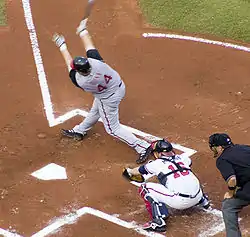
Compound of 三 (san, “three”) + 振 (shin, “swing”, in baseball, specifically a swing without a hit).[1][2]
Conjugation
Conjugation of "三振する" (See Appendix:Japanese verbs.)
| Katsuyōkei ("stem forms") | ||||
|---|---|---|---|---|
| Mizenkei ("imperfective") | 三振し | さんしんし | sanshin shi | |
| Ren’yōkei ("continuative") | 三振し | さんしんし | sanshin shi | |
| Shūshikei ("terminal") | 三振する | さんしんする | sanshin suru | |
| Rentaikei ("attributive") | 三振する | さんしんする | sanshin suru | |
| Kateikei ("hypothetical") | 三振すれ | さんしんすれ | sanshin sure | |
| Meireikei ("imperative") | 三振せよ¹ 三振しろ² |
さんしんせよ¹ さんしんしろ² |
sanshin seyo¹ sanshin shiro² | |
| Key constructions | ||||
| Passive | 三振される | さんしんされる | sanshin sareru | |
| Causative | 三振させる 三振さす |
さんしんさせる さんしんさす |
sanshin saseru sanshin sasu | |
| Potential | 三振できる | さんしんできる | sanshin dekiru | |
| Volitional | 三振しよう | さんしんしよう | sanshin shiyō | |
| Negative | 三振しない | さんしんしない | sanshin shinai | |
| Negative continuative | 三振せず | さんしんせず | sanshin sezu | |
| Formal | 三振します | さんしんします | sanshin shimasu | |
| Perfective | 三振した | さんしんした | sanshin shita | |
| Conjunctive | 三振して | さんしんして | sanshin shite | |
| Hypothetical conditional | 三振すれば | さんしんすれば | sanshin sureba | |
| ¹ Written imperative ² Spoken imperative | ||||
References
- Shōgaku Tosho (1988) 国語大辞典(新装版) [Unabridged Dictionary of Japanese (Revised Edition)] (in Japanese), Tōkyō: Shogakukan, →ISBN
- Matsumura, Akira, editor (2006), 大辞林 [Daijirin] (in Japanese), Third edition, Tōkyō: Sanseidō, →ISBN
This article is issued from Wiktionary. The text is licensed under Creative Commons - Attribution - Sharealike. Additional terms may apply for the media files.