| Te Uri-o-Hau | |
|---|---|
| Iwi (tribe) in Māoridom | |
 Kaiwaka | |
 | |
| Rohe (region) | Northland |
| Waka (canoe) | Māhuhu-ki-te-rangi |
| Population | 1,314 (2018 census)[1] |
| Website | www |
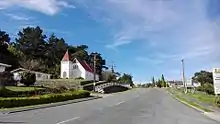
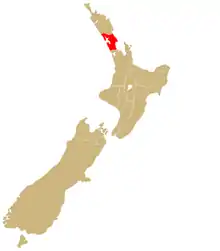
Te Uri-o-Hau (sometimes spelt Te Uri O Hau[2] or Te Uriohau[3][4]) is a Māori iwi (tribe) based around New Zealand's Kaipara Harbour.[5] It is both an independent iwi and a hapū (sub-tribe) of the larger Ngāti Whātua iwi, alongside Ngāti Whātua-o-Ōrākei, Te Roroa and Te Taoū.[6] Its rohe (tribal area) includes Dargaville, Maungaturoto, Mangawhai, Kaiwaka and Wellsford.[7]
According to the 2018 New Zealand census, about 1,314 people affiliate with the iwi.[1][8] This compares to 732 in 2001, 1,074 in 2006, and 1,260 in 2013.[9]
History
Former iwi leader Russell Kemp died in 2018 at the age of 71.[10][11][12]
Hapū and marae
Hapū
Te Uri-o-Hau is further divided into the following hapū (sub-tribes):
- Ngāi Tāhuhu
- Ngāti Kaiwhare
- Ngāti Kauae
- Ngāti Kura
- Ngāti Mauku
- Ngāti Rangi
- Ngāti Tāhinga
- Te Uri o Hau[5]
Marae and wharenui
The iwi has the following marae (meeting places) and wharenui (meeting houses):
- Naumai, Ngā Uri o te Kotahitanga, Ruawai
- Ngā Tai Whakarongorua and Ngā Tai Whakarongorua, Tinopai
- Ōruawharo and Kote Rangimārie, Wellsford
- Ōtamatea and Aotearoa, Whakapirau
- Ōtūrei and Rangimārie Te Aroha, Aratapu
- Parirau and Te Whare Mārama, Matakohe
- Rāwhitiroa and Rāwhitiroa, Tinopai
- Rīpia and Te Orikena, Rīpia
- Te Kōwhai and Te Kōwhai, Matakohe
- Te Pounga and Te Pounga, Kaiwaka
- Waihaua Arapaoa and Kirihipi, Tinopai
- Waikāretu Pōuto and Waikāretu, Te Kōpuru
- Waiōhou, Tinopai
- Waiotea, Tinopai [5]
Organisations
Te Uri o Hau Settlement Trust represents the iwi following its Treaty of Waitangi settlement with the New Zealand Government under Te Uri o Hau Claims Settlement Act 2002. It also represents the iwi as an "iwi authority" during the resource consent process under the Resource Management Act 1991. It is a Tūhono organisation and a trust, and its governance board includes two represents from each of the four Ngā Mātua marae: Otamatea, Waikaretu, Oruawharo and Arapaoa.[5]
The iwi has interests in the territory of Northland Regional Council, Auckland Council and Kaipara District Council.[5]
Religion
According to the 2018 New Zealand census, 53.6% of the iwi has a religious belief and 40% have no religious beliefs. By comparison, 38.1% for the Māori population as a whole has a religious belief.[13]
| Religious affiliation | % | |
|---|---|---|
| Irreligious | 40 | |
| Christianity | 32.1 | |
| Anglicanism | 8.2 | |
| Catholicism | 7.5 | |
| Christianity (no further description) | 5.7 | |
| Latter-Day Saints | 2.7 | |
| Methodism | 2.3 | |
| Pentecostal | 2.1 | |
| Presbyterian, Congregational and Reformed | 1.8 | |
| Evangelical, Born-Again and Fundamentalist | 1.1 | |
| Jehovah's Witnesses | 0.7 | |
| Māori Religions | 20.3 | |
| Rātana Church | 19.6 | |
| Other Māori religions and beliefs | 0.7 | |
| Spiritualism and New Age Religions | 1.8 | |
| Object to answering | 6.4 | |
Notable people
See also
References
- 1 2 "Te Uri o Hau". tewhata.io. Data Iwi Leaders Group. 25 June 2021. Retrieved 13 July 2021.
- ↑ "Te Uri O Hau". uriohau.com. Te Uri o Hau Settlement Trust.
- ↑ "Text of waiata: "He tangi na Ngati Whatua mo tana mate i Te Ika-a-ranganui. Na Puriri o Te Uriohau tribe"". University of Auckland Library Archives. Auckland University.
- ↑ "Maori deeds of land purchases in the North Island of New Zealand: Volume One". Victoria University.
- 1 2 3 4 5 "Te Puni Kōkiri Iwi Profile". tkm.govt.nz. Te Puni Kōkiri.
- ↑ "Ngāti Whātua". Te Ara - the Encyclopedia of New Zealand. Ministry for Culture and Heritage. 22 March 2017.
- ↑ "Te Uri o Hau Area of Interest from the Deed of Settlement" (JPG, 254KB). tkm.govt.nz. Te Puni Kōkiri. 13 December 2000. Retrieved 29 May 2018.
- ↑ "Iwi affiliation (estimated count), 2018". Statistics New Zealand.
- ↑ "2013 Census QuickStats about Māori – tables". Statistics New Zealand. Archived from the original on 13 July 2014. Retrieved 9 July 2017.
- ↑ "Te Uri o Hau mourn the loss of champion Russell Kemp". Waatea News. 12 January 2018. Retrieved 29 May 2018.
- ↑ "Honoured Northland iwi leader dies". Radio New Zealand. 11 January 2018. Retrieved 29 May 2018.
- ↑ "Russell Kemp, Northland kaumatua who 'exuded leadership', dies aged 71". NZ Herald. NZME. 13 January 2018. Retrieved 29 May 2018.
- ↑ "Religion - Te Uri o Hau". tewhata.io. Data Iwi Leaders Group. 25 June 2021. Retrieved 14 July 2021.
