Ma'ayan Baruch | |
|---|---|
 | |
  Ma'ayan Baruch 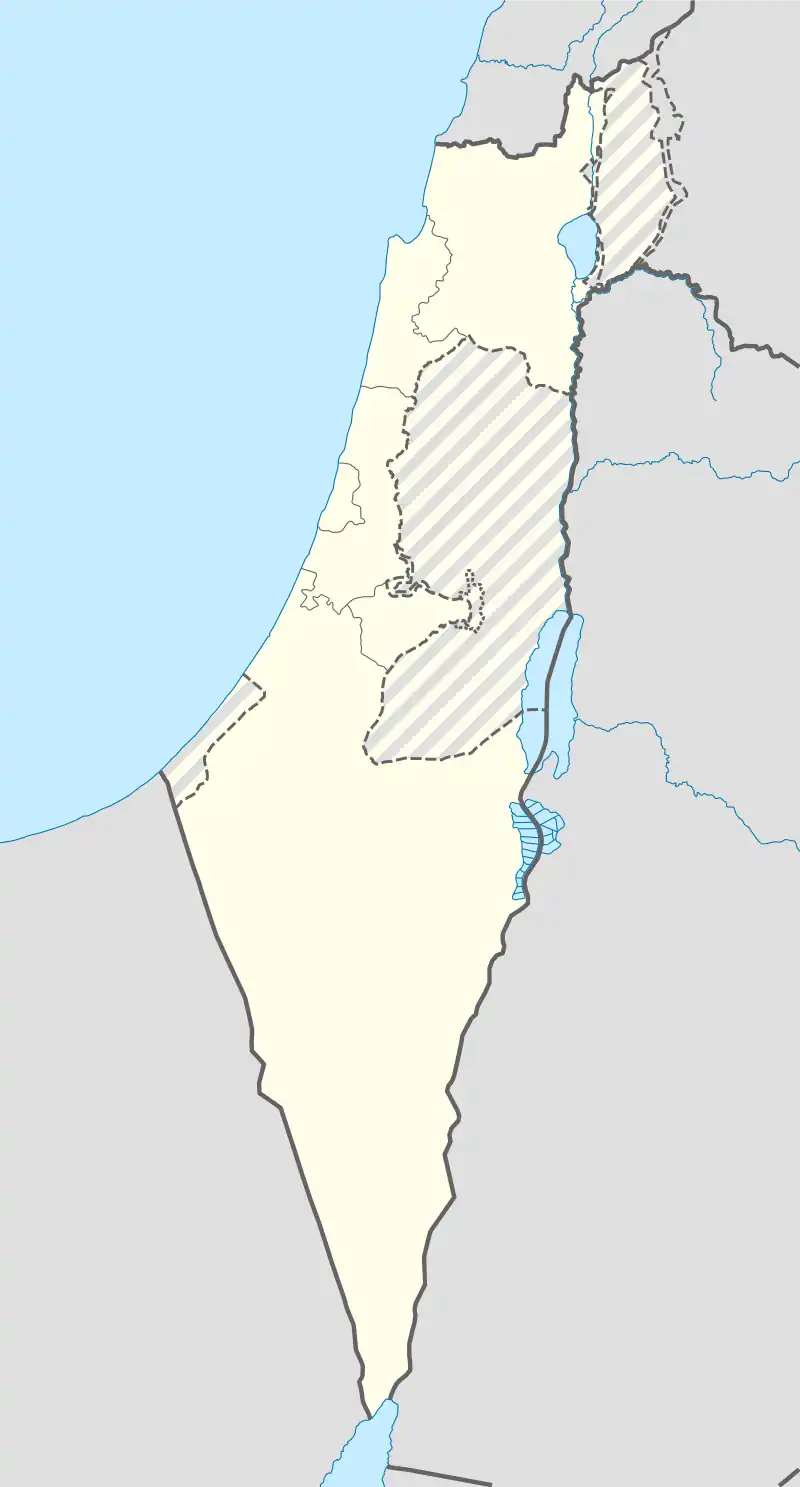 Ma'ayan Baruch | |
| Coordinates: 33°14′28″N 35°36′32″E / 33.24111°N 35.60889°E | |
| Country |  Israel Israel |
| District | Northern |
| Council | Upper Galilee |
| Affiliation | Kibbutz Movement |
| Founded | 11 March 1947 |
| Population (2021) | 723[1] |
Ma'ayan Baruch (Hebrew: מַעְיַן בָּרוּךְ, lit. 'Blessed Spring') is a kibbutz in northern Israel. Located near the Lebanese border, it falls under the jurisdiction of Upper Galilee Regional Council. In 2014 it had a population of 720.[1]
History
The kibbutz was founded on 11 March 1947,[2] on the site of Hamara, a moshav established by Jewish farmers in 1919 but abandoned in 1920 due to financial hardship and security issues. It was named for Baruch (Bernard) Gordon, a South African Zionist.[3] The founders were members of other kvutzot who had met in Kfar Giladi; members of the HaTenua HaMeuhedet youth movement, members of Habonim who immigrated to British Mandate of Palestine as Ma'apilim (illegal immigrants of Aliyah Bet), and members of a garin of pioneering soldiers from South Africa who fought in the British Army during World War II.[2]
After the 1948 Palestine war, Ma'ayan Baruch took over part of the land belonging to the newly depopulated Palestinian village of al-Sanbariyya.[4]
During the 2023 conflict between Hamas and Israel, northern Israeli border communities, including Ma'ayan Baruch, faced targeted attacks by Hezbollah and Palestinian factions based in Lebanon, and were evacuated.[5]
Development projects
A new neighborhood in Ma'ayan Baruch was built to attract newcomers and bring money into the kibbutz coffers in the wake of the socio-economic problems that have affected many kibbutzim since the 1980s. The newcomers are from other kibbutzim and townships in the region, as well as other parts of the country.[6]
Landmarks
A museum which holds a collection of prehistoric artifacts found in the Hula Valley, The Prehistoric Man Museum, is located on the kibbutz. The museum collection includes the skeleton of a prehistoric woman, approximately 50 years old, buried with her dog.[7][8]
Historic images
 Ma’ayan Baruch, 11 March 1947
 Early construction work on Ma'ayan Baruch on 1 March 1947. The 3 members of the British colonial Palestine Police Force pictured here include Amnon Assaf, founder of the Upper Galilee Museum of Prehistory.[10]
 Ma'ayan Baruch. First buildings 1947
 Ma’ayan Baruch 1947
Notable people
- Menashe Kadishman (born 1932), sculptor and painter
- Rela Mazali (born 1948), Israeli peace activist and writer
- Amnon Shamosh, Israeli author and poet
See also
- Notes from the Frontier, an account of life on the kibbutz in the mid-1960s by American author Hugh Nissenson.
References
- 1 2 "Regional Statistics". Israel Central Bureau of Statistics. Retrieved 22 February 2023.
- 1 2 "Une nouvelle colonie en Haute-Galilee". Hehaloutz. 1 June 1947.
- ↑ "Ma'yan Barukh | Encyclopedia.com". www.encyclopedia.com. Retrieved 23 November 2023.
- ↑ Khalidi, Walid (1992). All That Remains:The Palestinian Villages Occupied and Depopulated by Israel in 1948. Washington D.C.: Institute for Palestine Studies. p. 494. ISBN 0-88728-224-5.
- ↑ Fabian, Emanuel. "IDF to evacuate civilians from 28 communities along Lebanese border amid attacks". www.timesofisrael.com. Retrieved 22 October 2023.
- ↑ Depression in Margaliot, Hope in Maayan Baruch Haaretz, 11 July 2008
- ↑ James Serpell, The domestic dog: its evolution, behaviour, and interactions with people, pp 10–12. Cambridge University Press, 1995.
- ↑ SJM Davis and FR Valla, Evidence for domestication of the dog 12,000 years ago in the Natufian of Israel, Nature 276, 608–610 (7 December 1978)
- ↑ "Volume 134 Year 2022 Ma'ayan Barukh". www.hadashot-esi.org.il. Retrieved 23 November 2023.
- ↑ "Founder Biography | english". www.ugmp.co.il. Archived from the original on 14 April 2014.